The best lightweight mobility scooter, and the honest truth about "lightweight"
Years of fitting riders taught me where "lightweight" claims die: at the trunk of a car, with a spouse or an adult child trying to wrestle a scooter into the back seat. The number on the website is rarely the number that matters. What your back deals with is the single piece you actually have to lift, and that is where the marketing and the reality part ways.
Below is my ranking of the lightest, easiest-to-handle scooters I trust, with the tradeoffs named plainly. A lighter machine almost always asks you to give something up, usually weight capacity or range. My job is to help you choose the compromise you can live with, not to chase the lowest number on a spec sheet.
What "lightweight" really means (total weight vs the heaviest piece)
Two numbers get mixed up whenever people shop for a light scooter: the total assembled weight, and the weight of the heaviest single piece once it comes apart. The second one is what saves your back. On this list, the figures that actually decide whether a scooter fits your car are the EV Rider's 49 lb whole unit (it folds rather than splits), the Go-Go's 35 lb heaviest section, and the Scout's roughly 94 lb total that breaks into chunks no single one of which is small. For why the heaviest piece beats the spec-sheet total, the weight and size guide lays it out model by model with the full table.
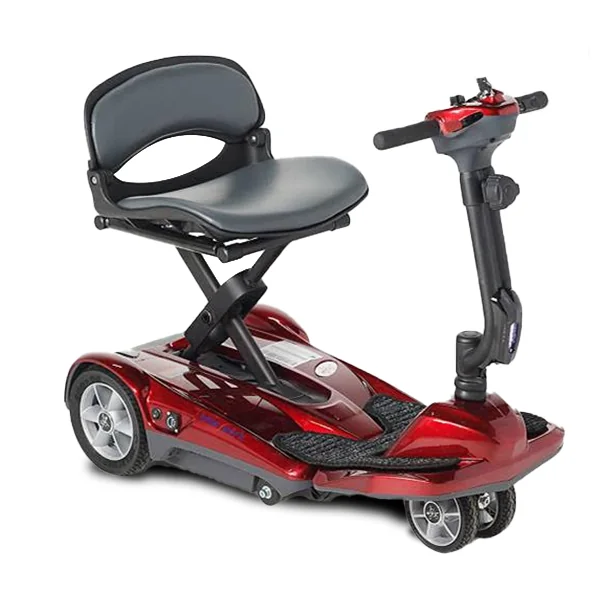
My top pick: EV Rider Transport AF+ (the lightest, and it folds itself)
This is the one I point people to when they want the genuinely lightest option that asks the least of their body. The EV Rider Transport AF+ weighs about 49 lbs total, the lowest number on this whole list, and it folds and unfolds by remote control. Press a button and it tucks itself down. No breaking it into pieces, no lifting a battery pack, you just guide the folded unit. For a spouse who is not strong, or for one person living alone, that auto-fold changes the entire relationship with the machine.
It runs on a lithium battery approved for airlines and cruises, so this is the scooter I recommend for anyone who actually flies. That is a real capability, not a slogan: most scooters cannot board a plane, this one can, which is also why it doubles as my best folding pick.
You pay for that convenience in three ways. Weight capacity is 250 lbs, the lowest here, so it is the wrong machine for a larger rider. Top speed sits at a gentle 3.8 mph, fast enough to feel steady and confident on a sidewalk rather than to cover ground quickly. Range runs up to 10 mi, fine for errands and travel but not for long days. With a 31 in turning radius it works as a precision tool for tight spaces, not an all-day workhorse. When those tradeoffs match your life, nothing else here is this easy to handle. The full EV Rider Transport AF+ review has the details.
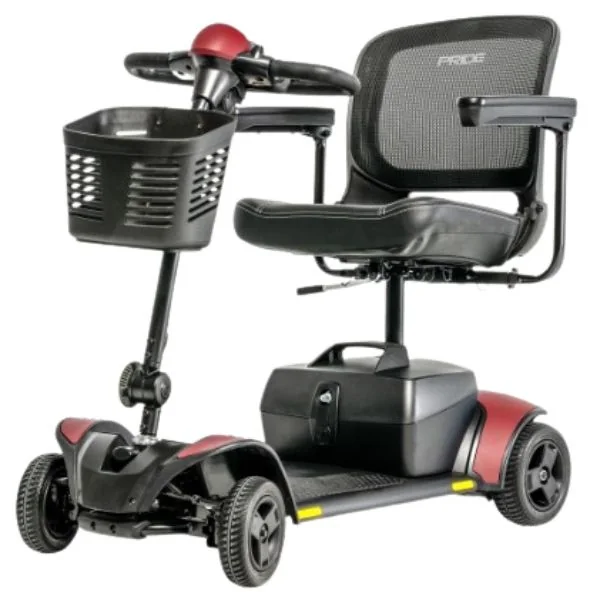
Runner-up: Pride Go-Go Elite Traveller 2 (lightest pieces to lift)
When the auto-fold is more than you need or more than your budget allows, the Pride Go-Go Elite Traveller 2 is the one I reach for next, and for many families it is the smarter buy. It does not fold in one piece. It splits into five parts, and the heaviest of them is only about 35 lbs. Most caregivers can manage that, and two average-strength people can load it without strain.
It carries up to 300 lbs, which suits more riders than the EV Rider, and it reaches 13.8 mi on the larger 18 Ah battery, noticeably more than you get from the smaller 12 Ah option. Pride's iTurn steering keeps the turning radius to a tight 37 in, so it handles a kitchen or a store aisle better than its size suggests. Top speed is a calm 4.25 mph.
This is the best balance of light pieces, real range, and sensible capacity in the lineup, which is exactly why it leads my best travel scooter rankings. The catch: you disassemble it every single time, four lifts plus the seat. Daily bending and lifting of several pieces is the problem the auto-fold EV Rider solves, and it earns its higher price for anyone facing that. With a helper, or with only occasional breakdowns, the Go-Go is the value pick. The Go-Go Elite Traveller 2 review walks through the assembly step by step.
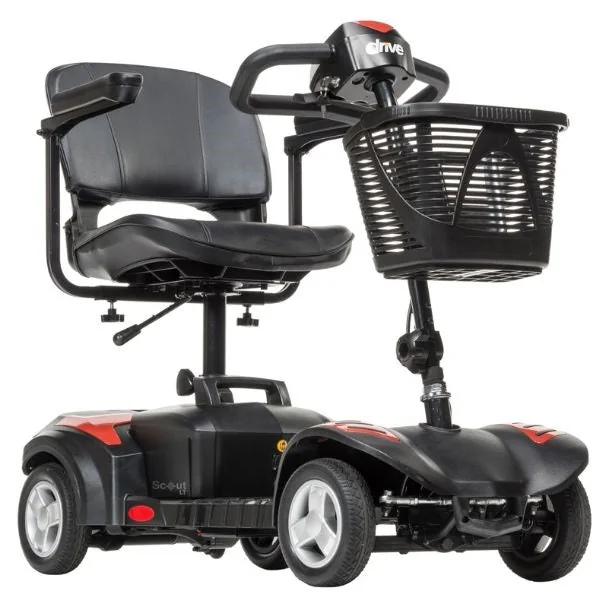
Best budget lightweight: Drive Medical Scout
For a tight budget that still needs a scooter that comes apart for transport, the Drive Medical Scout is the one I trust at around $849. It is a 4-wheel travel scooter that splits into pieces for the trunk, carries up to 300 lbs, and rides on flat-free tires so a puncture never strands you. Basic, and I mean that as praise, because there is less to break.
Total weight is about 94 lbs, so do not let the word travel fool you into picturing a feather-light machine. The point is that it breaks down, not that any one section is small. Standard range reaches 9 mi, or about 15 mi with the extended battery, and it tops out at 4.25 mph. The one drawback I flag for tight homes is the turning radius. At 53.75 in it is the widest here, so it needs more room to come about than the nimble Go-Go does.
I steer the Scout toward someone who wants a dependable, no-frills machine, often as a first scooter, where stability and a fair price outrank the last word in lightness. It shows up on my best scooter for seniors shortlist for that same reason. The full breakdown sits in the Drive Medical Scout review, and anyone weighing the two budget travel options can see them lined up in my Go-Go vs Scout comparison.
How these three compare at a glance
Here is the part that matters most for a lightweight buyer, lined up in one place. Notice that the lowest total weight (EV Rider) does not give you the lowest single-piece lift, because it folds instead of coming apart. And the scooter with the lightest piece to carry (Go-Go) still weighs more in total. That tension is the whole story of lightweight scooters.
| Scooter | Total weight | Heaviest piece / fold | Capacity | Range | Turning radius |
|---|---|---|---|---|---|
| EV Rider Transport AF+ | about 49 lbs | Auto-folds, no disassembly | 250 lbs | up to 10 mi | 31 in |
| Pride Go-Go Elite Traveller 2 | splits into 5 pieces | heaviest about 35 lbs | 300 lbs | up to 13.8 mi | 37 in |
| Drive Medical Scout | about 94 lbs | Splits into pieces (heavier) | 300 lbs | up to 9 mi (about 15 mi extended) | 53.75 in |
When the lift is your hardest problem, the EV Rider answers it best. When you need range plus a manageable lift, the Go-Go wins. When price decides it, the Scout earns its keep.
How to choose the right lightweight scooter for you
After all the years I have done this, the decision comes down to a short checklist. Work through it in order and the answer usually picks itself.
- Who lifts it, and how strong are they? One person with a bad back, or no helper at all, points hard toward the auto-folding EV Rider. Letting the machine do the work is worth real money.
- What is the rider's weight, honestly? The EV Rider stops at 250 lbs. A rider near or above that needs the Go-Go or Scout at 300 lbs, and a heavier rider may need something off this list entirely. Capacity is a safety number, not a suggestion.
- How far do you really go? Errands and travel sit comfortably inside 9 to 10 mi. Longer outings want the Go-Go's 13.8 mi for breathing room. Cold weather and hills shorten every range claim, so the battery guide is worth reading before you trust any mileage number.
- Do you fly or cruise? Only the lithium EV Rider is built and approved for that. The lead-acid scooters are cheaper and steadier, but they stay home.
The longer version of this thought process lives in how to choose a mobility scooter, where turning radius and the spaces you actually move through carry far more weight than top speed. And do not skip the simple step of measuring the rider, the doorways, and the car trunk before you order. I have watched too many returns that a tape measure would have prevented.
Compare our tested picks side by side, with real specs, photos and honest pros and cons.
Independent and reader-supported. Some links in our reviews are affiliate links that never change our rankings. How we test.
Frequently asked questions
What is the lightest mobility scooter you recommend?
The EV Rider Transport AF+ is the lightest on my list at about 49 lbs total, and it folds and unfolds itself by remote control, so you are not hoisting heavy pieces. The tradeoff is a lower 250 lb weight capacity and a gentler 3.8 mph top speed. If the lightest single piece to carry matters more to you than the lowest total weight, the Pride Go-Go Elite Traveller 2 has a heaviest section of only about 35 lbs.
Does total weight or the heaviest piece matter more?
For most people the heaviest single piece matters more, because that is what your back actually lifts. A scooter that weighs 94 lbs total but breaks into pieces around 30 to 40 lbs can be easier to handle than a lighter one that goes in as a single solid unit. The exception is an auto-folding scooter like the EV Rider, where the machine folds itself, so the total weight is mostly what you guide rather than lift. The weight and size guide breaks this down by model.
Are lightweight scooters less stable or capable?
They make real tradeoffs, yes. To stay light, these scooters tend to carry less weight, travel shorter distances, and run slower than full-size models. They are steady enough for indoor use, sidewalks, and errands, but they are not built for long days or rough ground. A full-size scooter rides better when you want more cushion and capability and can manage the transport. My heavy-duty rankings cover that end of the range.
Can a lightweight scooter go on an airplane?
Only the right kind. The EV Rider Transport AF+ uses a lithium battery approved for airlines and cruises, which is why it is my pick for anyone who flies. The lead-acid models on this page, like the Drive Medical Scout, are not approved for air travel. Always confirm the current rules with your specific airline before you book, because policies change and they can be strict.
Will Medicare pay for a lightweight travel scooter?
Treat any coverage as a bonus and plan to pay out of pocket, because travel models chosen for getting around outside the home often fall outside what Medicare will approve. Coverage is never guaranteed, the paperwork is demanding, and the eligibility rules are stricter than people expect, so talk to your doctor and your plan about your specific situation. My Medicare coverage guide explains how the process generally works, and I am a mobility specialist rather than a clinician, so see how we test for where my advice stops.

I spent years helping older adults choose and fit mobility scooters, and I test these myself. I write every review and guide here, and I rank by what actually keeps a rider safe and independent, not by who pays the most. I am not a doctor. How we test →