Pride Go-Go Elite Traveller 2 review
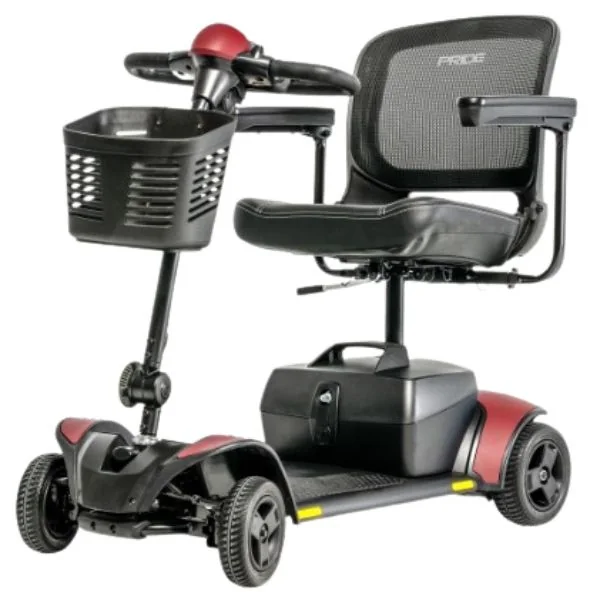
The travel scooter most seniors end up on, and for good reason. Pride iTurn technology gives it a 37 inch turning circle, tight enough for real indoor use, while it still splits into five pieces with the heaviest around 35 pounds. With the larger battery it reaches close to 14 miles.
Check price at Pride →- Very tight 37 in turning circle for a 4-wheel
- Splits into five pieces, heaviest about 35 lbs
- Up to 13.8 miles with the 18 Ah battery
- Backed by Pride dealer and parts support
- Easy feather-touch take-apart
- Slow 4.25 mph top speed
- 300 lb weight capacity
- Small tires struggle off smooth pavement
- Basket is an add-on on some packages
A daughter once cornered me in the showroom with a phone full of tabs, and every one of them was some version of the Pride Go-Go Elite Traveller 2. Her mother was standing right there, a little embarrassed, asking if it would actually fit through her bathroom door. That scene plays out for me constantly, and it tells you something: this is the travel scooter most families circle back to, and the reasons are practical, not accidental. It turns tight enough to live indoors, it breaks down into pieces a spouse can lift, and Pride is a name your local dealer almost certainly stocks and services.
So in this review I am going to skip the brochure talk and tell you what the numbers mean on the ground: the indoor turning, the lift weight that actually matters, the gap between the two battery options, and the honest limits nobody mentions until you are stuck on a gravel path. I have sat plenty of riders on this scooter, folded it into a trunk with them, and watched it succeed or fall short in real homes, so that is the lens I will use.
Why so many seniors end up on this scooter
When I sit a new rider in the Go-Go Elite Traveller 2, three things usually click into place at once. It feels manageable, it feels familiar, and it feels supported. None of those is glamorous, but they are exactly what makes a scooter something you keep using instead of something that gathers dust in the garage.
This is a 4-wheel travel scooter, which means it is built to come apart and ride in a car, not to conquer trails. It carries up to 300 lb, runs at about 4.25 mph, and is designed first and foremost for getting around stores, sidewalks, medical appointments, and the occasional family outing. It is not the fastest or the longest-range scooter I recommend, and the limits get their own section below. What it does well is the everyday stuff, and it does it without overwhelming the person riding it or the person helping them.
Not sure yet whether a travel scooter is even the right category for you? Start a step back, with my guide on the best mobility scooters for seniors and the broader roundup of travel scooters. This Pride sits near the top of both lists for good reason.
The 37 in iTurn radius is the real headline
Top speed gets all the attention, but for an older rider the number that changes daily life is the turning radius. The Go-Go Elite Traveller 2 uses Pride's iTurn setup to get down to a tight 37 in turning radius, and that is genuinely small for a 4-wheel scooter. Put plainly, a 4-wheeler that needs a wide arc will get you stuck in a kitchen, a narrow hallway, or a crowded pharmacy aisle. This one mostly does not.
I have watched riders pivot it inside a small bathroom doorway and back it out of a checkout lane without a three-point turn. That matters more than you would expect, because the scooters people abandon are usually the ones that cannot get them where they actually want to go. A tight turn keeps the scooter useful indoors as well as out, and for a lot of my clients that indoor capability is the whole point.
By contrast, a budget travel scooter like the Drive Medical Scout has a much wider turning arc, which is fine in a parking lot but frustrating in a tight home. When indoor maneuvering ranks high on your list, the iTurn is one of the strongest arguments for spending a little more here. I weigh turning radius against everything else in how to choose a mobility scooter.
Taking it apart: the piece you actually lift is 35 lb
The Go-Go Elite Traveller 2 splits into 5 pieces, and the one that trips people up is the heaviest: about 35 lb. That is the number to plan your lift around, not the 5-piece total, because you never hoist the whole scooter at once. Pride calls it feather-touch disassembly, and while no scooter is truly featherlight, the design is sensible. The frame uses simple latches, the seat lifts off, the battery pack comes out, and the pieces nest reasonably well in a standard sedan trunk.
I usually tell the family member who will be doing the lifting to practice it once in the showroom or driveway before they buy. A 35 lb piece is heavier than what you handle on an auto-folding scooter like the EV Rider Transport AF+, but lighter than the 53 lb piece on the Golden Buzzaround EX, so this Pride sits in a comfortable middle. If that one piece feels easy for whoever loads the car, you are in good shape. If it is a strain, that is your sign to look at a lighter option.
Why the heaviest piece beats the spec-sheet total is laid out, model by model, in my guide to weight capacity and size.
Range: the 12 Ah versus 18 Ah battery decision
This scooter ships with a battery choice, and it is worth understanding before you order. With the larger 18 Ah battery, Pride rates the range at up to 13.8 mi. The smaller 12 Ah battery gives you noticeably less. That gap is the single biggest reason I see buyers either delighted or disappointed, so do not gloss over it.
Keep in mind that 13.8 mi is a ceiling measured under ideal conditions, and your real number will land lower once you add a heavier rider or a hill. So the battery question is really a margin question. Needing 10 mi of dependable use? Lean toward the 18 Ah pack rather than counting on the smaller one to stretch.
- Choose the 18 Ah battery if you want margin, take longer outings, or carry more weight. The peace of mind is worth it.
- The 12 Ah battery can be fine for short, predictable trips, like one store and back, but do not buy it expecting all-day range.
Both are lithium-friendly travel batteries that pop out for charging or for lightening the load before you lift. To understand charging habits, lifespan, the half-to-two-thirds rule of thumb on real-world range, and the lithium versus lead-acid tradeoff, my battery guide walks through all of it.
Comfort, stability, and the honest limits
This is where a fair review earns its keep, so here is the balanced picture. The Go-Go Elite Traveller 2 is comfortable enough for the errands and appointments it is built for. Its 4-wheel layout gives it steadier footing than a 3-wheeler, a reassuring trait for anyone who values stability over the tightest possible turn. The seat is adequate for shorter rides, and the controls are simple and intuitive, which I appreciate for first-time riders.
The limits are real, though. At about 4.25 mph it is slow, by design, so it is a poor match for someone who wants to keep pace on a long walk or cover ground quickly. The scooter rolls on small flat-free tires, which means no punctures and no upkeep, but they feel every crack and they struggle on grass, gravel, thick carpet edges, and uneven ground. There is no suspension, so a bumpy sidewalk comes through. And the seat, while fine for an hour of shopping, is not the plush all-day throne you get on a heavier comfort model. The full case for solid versus air-filled tires sits in how to choose a mobility scooter.
None of that is a flaw so much as a tradeoff. Pride built a scooter that is easy to transport and easy to maneuver indoors, and those choices cost you speed, outdoor grip, and ride cushioning. Buyers who know going in that this is a pavement-and-indoor machine end up happy. Anyone expecting to cross a park lawn will not be.
Who it suits, and who should look elsewhere
After fitting a lot of riders, I have a pretty clear sense of who this scooter is right for and who should keep looking.
The Go-Go Elite Traveller 2 is a great fit when you need to maneuver indoors as well as outdoors, where that tight 37 in turn really pays off, and you have a helper who can comfortably lift a 35 lb piece into a trunk. It rewards riders who stick mostly to smooth surfaces, who weigh up to 300 lb and want a steady 4-wheel base, and who value a trusted brand with dealers who can service it locally. If that describes your life, this is an easy scooter to live with.
The wrong-fit cases are just as clear:
- Flying or cruising often? Look at the auto-folding EV Rider Transport AF+, which goes up in one piece and is airline approved, though it carries a lower 250 lb limit.
- Care most about ride comfort and a cushioned seat? The Golden Buzzaround EX adds suspension and a higher 350 lb capacity, at the cost of a much heavier 53 lb lift piece.
- On a tight budget and able to accept a wider turn? The Drive Medical Scout is the value pick.
- Spending real time on grass, gravel, or rough ground? A travel scooter is the wrong tool. My travel scooter guide shows where each one fits.
The closest head-to-head question I get is Pride versus the Scout, and I lay out exactly when each one wins in my Go-Go versus Drive Scout comparison.
How I evaluated it and the bottom line
I do not just read spec sheets. I look at how a scooter behaves for the person who will use it every day: how it turns in a real room, how the heaviest piece feels in your hands, how the rated range holds up once you add a rider and a hill, and whether the brand stands behind it. You can read the full process, including where I draw the line on what I will and will not advise, in how we test.
The bottom line is simple. The Pride Go-Go Elite Traveller 2 is the travel scooter most seniors land on because it gets the fundamentals right: a tight indoor turn, a manageable 35 lb lift, a real battery upgrade path, a steady 4-wheel base, and dealer support you can lean on. It is slow and it dislikes rough ground, and you should buy it knowing that. Inside those limits, it is one of the easiest scooters I can recommend to a family that wants something practical, transportable, and built to be used.
Check current pricing and any bundle or free-shipping deals from a trusted mobility retailer. Prices move with sales.
Affiliate link. We may earn a commission at no extra cost to you. It never changes our rankings (see how we test). We are not a medical provider; for a prescription scooter, talk to your doctor.
Frequently asked questions
Is the 12 Ah or 18 Ah battery worth the difference?
In most cases I lean toward the 18 Ah battery. It is rated for up to 13.8 mi versus a noticeably shorter range on the 12 Ah, and your real-world mileage always lands under the rating once a heavier rider, hills, or cold weather enter the picture. Riders who only ever take short, predictable trips can do fine with the 12 Ah. Anyone who wants margin so they are not nursing a low battery home should pay for the bigger pack. There is more on this in my battery guide.
How heavy is the Go-Go Elite Traveller 2 to lift into a car?
It splits into 5 pieces, and the heaviest single piece is about 35 lb. That is the number that matters, because you never lift the whole scooter at once. I always tell the family member who will be loading it to practice lifting that piece once before buying. When 35 lb feels comfortable, you are set. When it feels like a strain, look at a lighter auto-folding option like the EV Rider Transport AF+.
Can I use this scooter indoors?
Yes, and that is one of its real strengths. The Pride iTurn gives it a tight 37 in turning radius, which is small for a 4-wheel scooter, so it can pivot in tighter rooms, hallways, and store aisles than most travel scooters. Just keep it on smooth floors. The small flat-free tires and lack of suspension make it a pavement-and-indoor machine, not an off-road one.
Will Medicare pay for it?
I am a mobility specialist rather than a benefits advisor, so treat this as orientation, not gospel. Medicare Part B may help with a scooter only when a doctor prescribes it for a medical need inside your home, and the paperwork rules are strict. Many travel scooters bought mainly for outings do not qualify, and coverage is never guaranteed. Talk to your doctor and your plan about your specific situation, and read my plain-English overview of whether Medicare covers mobility scooters before you assume anything.
How is it different from the Drive Medical Scout?
Both are 4-wheel travel scooters with a 300 lb capacity and similar speed, but they aim at different buyers. The Scout is the budget pick with a much wider turning arc, so it is steady outdoors but awkward in tight indoor spaces. The Go-Go Elite Traveller 2 costs more and gives you that tight 37 in turn plus a stronger battery upgrade path. I break down exactly when each one wins in my Go-Go versus Drive Scout comparison.

I spent years helping older adults choose and fit mobility scooters, and I test these myself. I write every review and guide here, and I rank by what actually keeps a rider safe and independent, not by who pays the most. I am not a doctor. How we test →