The best travel mobility scooter for getting out and going places
A travel scooter has one job above all others: it has to come apart, get lifted into a car, and go back together without wearing you out before the trip even starts. The model that wins someone over on the showroom floor is often the one that ends up parked in the garage because loading it turns into a daily chore. So I rank these by how they live in your life, not by the brochure. (For the testing method and my background behind these calls, see how we test.)
My top three for most people are the Drive Medical Scout if you want the most affordable way to get rolling, the Pride Go-Go Elite Traveller 2 if you want a tighter turn and a lighter heaviest piece, and the EV Rider Transport AF+ if you fly or cruise and want a scooter that folds itself. Below I explain who each one suits and the real trade-offs, because the right pick depends on your body, your car, and where you are headed.
My top picks for a travel mobility scooter
Here is the short version, then I dig into each one. All three come apart or fold for the trunk, all three are stable four-wheel designs, and none of them is built for speed. On a travel scooter that hardly matters: turning radius and the weight you have to lift shape your day far more than top speed, which is exactly the priority order I walk through in my guide to choosing a mobility scooter.
| Scooter | Best for | Heaviest piece | Range | Turning radius |
|---|---|---|---|---|
| Drive Medical Scout | Budget, first travel scooter | Splits into pieces (about 94 lbs total) | Up to 9 mi (about 15 mi extended) | 53.75 in (wide) |
| Pride Go-Go Elite Traveller 2 | Tight spaces, easier lifting | About 35 lbs | Up to 13.8 mi (18 Ah battery) | 37 in (tight) |
| EV Rider Transport AF+ | Flying and cruising | About 49 lbs (folds in one piece) | Up to 10 mi | 31 in (tight) |
Still deciding what kind of scooter fits your life at all? That same choosing guide walks through it step by step. And if low weight is your single biggest concern, look at my lightweight picks.
1. Drive Medical Scout, the budget pick that just works
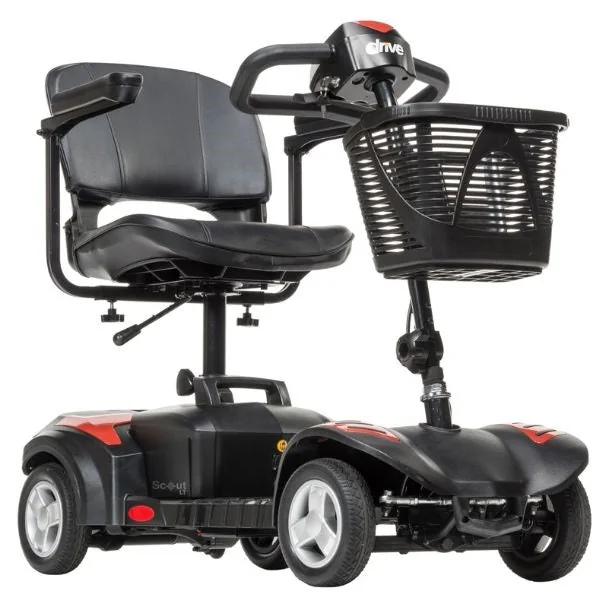
The Scout is where I send a lot of first-time buyers, and the reason is simple: it is the least expensive way to get a stable, honest travel scooter under you. At around $849 it does the basics well. It is a four-wheel design, which means it sits steady and does not feel tippy when you reach for something or turn on a slope. Its tires are flat-free, so a puncture can never strand you far from home, though they do ride a touch firmer over cracks than air-filled ones; my choosing guide lays out that tire trade-off in full.
Range is the modest part. You get up to about 9 miles on the standard battery, and roughly 15 miles if you spring for the extended pack. Treat 9 miles as a ceiling rather than a promise, since real-world conditions trim it (the battery guide explains why). For a farmers market, a mall loop, or a doctor's appointment, that is plenty. For a full day at a theme park, it may not be, so think honestly about your longest outing.
The catch worth knowing: the Scout comes apart for the trunk from a 94 lb total, so check which single piece lands in your hands before you commit. Its turning radius is also a wide 53.75 inches, which means tight store aisles and small bathrooms take some planning. On open sidewalks and parking lots you will never notice. In a cramped apartment, one of the tighter-turning scooters below may serve you better. Read the full Drive Medical Scout review for who it fits and who it does not.
2. Pride Go-Go Elite Traveller 2, lighter to lift and tighter to turn
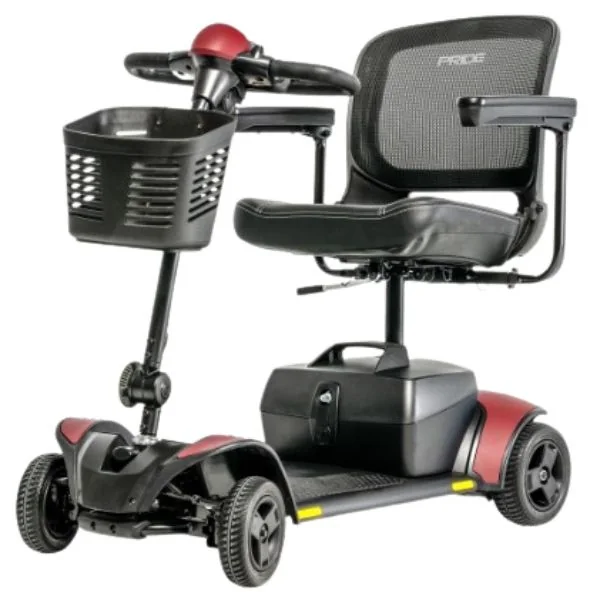
If I had to hand one travel scooter to the widest range of people, this might be it. The Go-Go Elite Traveller 2 splits into 5 pieces, and the heaviest piece is about 35 lbs. That number is the one that matters: you lift the heaviest single chunk, not the whole machine, and 35 lbs is something many caregivers and many riders can manage with care. Compare that to wrestling a one-piece scooter and you see why this design is so popular.
It also turns in a tight 37 inches thanks to Pride's iTurn geometry, so it handles narrow hallways and shop aisles far better than the Scout. Range reaches up to 13.8 miles with the larger 18 Ah battery, but the smaller 12 Ah pack delivers noticeably less, so confirm which battery you are buying and plan around its real figure rather than the headline.
The trade-offs are gentle. The flat-free tires are small, so it rides a little firmer over bumps than a bigger-wheeled scooter. And while the heaviest piece is light, you are still handling 5 separate parts every time you load and unload, which takes a minute. For most travelers that is a fair deal. My full Go-Go Elite Traveller 2 review covers the battery choice in detail, and when buyers are torn between this and the Scout, I put them head to head in Pride Go-Go vs Drive Scout.
3. EV Rider Transport AF+, the one built to fly
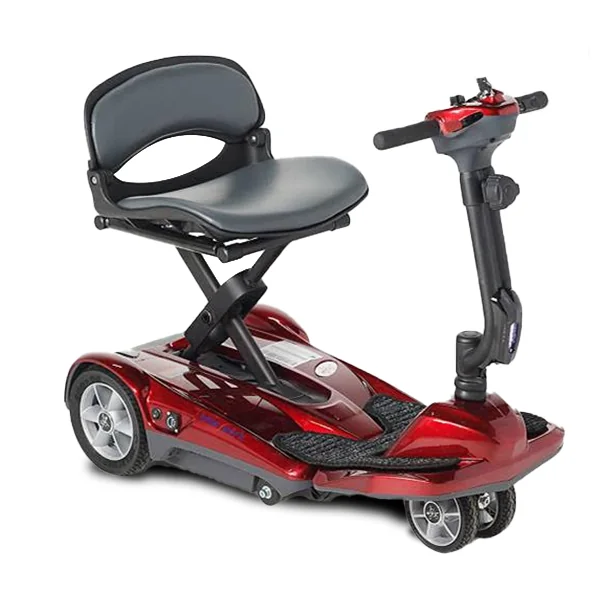
This is the scooter I recommend when flying or cruising is the whole point. The Transport AF+ folds and unfolds by remote control, so you press a button and it collapses itself. No taking it apart, no lining up 5 pieces in the trunk. It goes up in one piece, and at just 49 lbs it is genuinely manageable to wrestle into a car or hand to airport staff. Because it travels as one unit rather than splitting into chunks, that 49 lbs is the figure you live with every time, so weigh it against your trunk and your back honestly.
The feature that earns its keep is the lithium battery, which is approved for airlines and cruises. Airline rules around scooter batteries are strict and they vary by carrier, so call ahead and confirm with your specific airline before you travel. Starting with a battery already cleared for flight removes the biggest headache. Its 31 inch turning radius is tight too, so it threads through airports, hotel rooms, and narrow aisles with ease.
One limit deserves a hard look. The Transport AF+ has the lowest weight capacity of this group at 250 lbs, a top speed of 3.8 mph, and a range of up to 10 miles. It is built to be light and packable, and those numbers are the price of that. Riders near or above 250 lbs should pass on this one and choose a sturdier model. Within that limit, the convenience is hard to beat. The full EV Rider Transport AF+ review goes deeper, and for more packable options, see my best folding mobility scooter picks. (As a recreational travel model, it almost never qualifies for Medicare, so budget to pay for it yourself and treat any coverage as a bonus; more on that in my Medicare coverage guide.)
The heaviest-piece rule, the one number most people miss
People weigh the total of a travel scooter and either panic at it or wave it off, and neither reaction answers the right question. When a scooter comes apart, the heaviest single piece is what you actually handle, so that is the number to write down. On the Go-Go Elite Traveller 2 it is about 35 lbs. On the EV Rider it is the whole folded unit at 49 lbs. The Scout splits from a 94 lb total, so check which piece you end up holding. I dig into the model-by-model breakdown, including why this figure beats the spec-sheet total, in my weight and size guide.
Once you have that figure, test it. Lift something of that weight at home before you buy: a bag of water softener salt or a couple of gallons of water gives you a real sense of it. Then put a few practical questions to yourself.
- Think about who lifts it. When a caregiver loads the scooter, their strength sets the limit, not yours.
- Think about your trunk height. Hoisting 35 lbs to waist level is one thing. Heaving it over a tall SUV liftgate is another.
- Consider a trunk hoist or lift if no piece is light enough to manage safely. That can change which scooter is realistic for you.
This one habit prevents more disappointment than any spec on the page.
Disassembly vs auto-fold, and how far you really need to go
Travel scooters split into two camps, and knowing which you want narrows the field fast. Most of them, including the Scout and the Go-Go Elite Traveller 2, come apart into pieces. That keeps the heaviest single piece light, but you handle several parts each trip and need a clear spot to set them down. The EV Rider sits in the smaller camp that auto-folds into one piece by remote, which loads faster and travels best by plane.
Range deserves the same realism. These three run from about 9 miles up to 13.8 miles on a charge, depending on model and battery, but rated range is a best-case ceiling rather than a guarantee, so plan for noticeably less and charge fully the night before any big outing. My battery guide spells out the factors that shrink it. Riders who regularly want serious distance or rougher ground may find a travel scooter is the wrong tool entirely, in which case my outdoor scooter picks are a better starting point. For everyday errands, appointments, and getting around on trips, these three have the legs.
Compare our tested picks side by side, with real specs, photos and honest pros and cons.
Independent and reader-supported. Some links in our reviews are affiliate links that never change our rankings. How we test.
Frequently asked questions
What is the best travel mobility scooter overall?
For most people I point to the Pride Go-Go Elite Traveller 2 because it balances a light heaviest piece, about 35 lbs, with a tight 37 inch turn and solid range. When budget leads, the Drive Medical Scout is the most affordable stable pick. For flyers, the EV Rider Transport AF+ folds by remote and carries an airline-approved battery. The right one really depends on your body, your car, and where you go.
Can I take a travel mobility scooter on an airplane?
Some travel scooters are built for it and others are not, and the battery is the deciding factor. The EV Rider Transport AF+ uses a lithium battery that is approved for airlines and cruises, which is why I recommend it for flyers. Even so, airline rules around scooter batteries are strict and they differ from carrier to carrier. Always call your specific airline well before you travel to confirm what they allow and how they want it handled.
How heavy is too heavy for a travel scooter?
There is no single magic number, because the heaviest single piece you lift matters more than the total. A piece around 35 lbs, like the one on the Go-Go Elite Traveller 2, is manageable for many people with care. Before you buy, try lifting that weight at home and into your actual trunk. When no piece is light enough to lift safely, a trunk lift or hoist beats forcing it. My weight and size guide breaks the figures down model by model.
Does Medicare cover a travel mobility scooter?
Usually not. Travel and recreational scooters rarely meet the in-home medical-need standard Medicare uses, so plan to pay out of pocket and treat any help as a bonus. Coverage is never guaranteed, so talk to your doctor first and read my Medicare coverage guide for what the process involves before you count on it.
Is a 3-wheel or 4-wheel travel scooter better?
It depends on where you ride. Three wheels turn tighter, which helps indoors and in cramped spaces. Four wheels are steadier and feel more planted, especially on slopes or uneven ground, which is why all three of my travel picks here are four-wheel designs. When stability worries you, lean four-wheel. I break down the trade-offs in 3-wheel vs 4-wheel mobility scooter.

I spent years helping older adults choose and fit mobility scooters, and I test these myself. I write every review and guide here, and I rank by what actually keeps a rider safe and independent, not by who pays the most. I am not a doctor. How we test →