Drive Medical Scout review
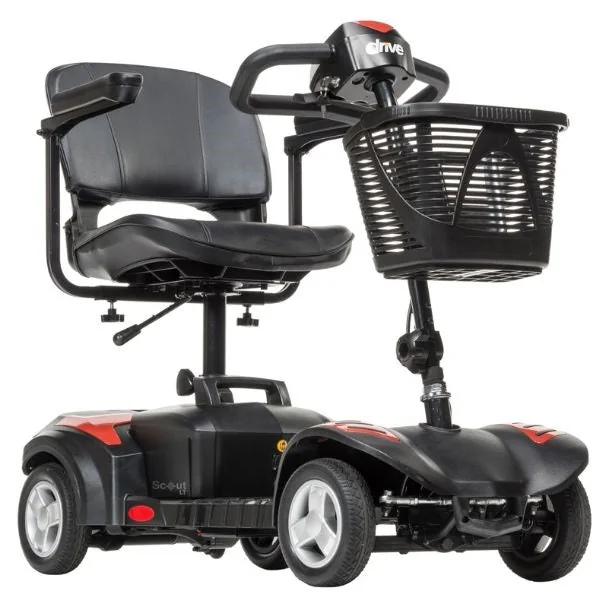
The lowest-cost way onto four wheels. The Scout splits into a few light pieces for the trunk, runs flat-free tires, and gets a smaller rider around the store or the block. The standard battery is short on range, so step up to the extended pack if you go further than a few blocks.
Check price at Drive Medical →- Lowest price on this list
- Splits into light pieces for the car
- Flat-free tires, no air to lose
- Simple controls, easy first scooter
- Four wheels for added stability
- Only about 9 miles on the standard battery
- Wide 53.75 in turning circle indoors
- Basic seat and padding
- Modest 4.25 mph top speed
A daughter once wheeled the Drive Medical Scout up to my fitting table and said, "It was the cheapest four-wheeler the store had, so we grabbed it, but now Mom hates it." We spent twenty minutes and found the real problem in five: their hallway. At around $849, the Scout is one of the most affordable four-wheel travel scooters families seriously consider, and that low price is the entire story. The question worth asking is not whether it is cheap but whether it is the right kind of cheap for the person who will ride it. For some riders the Scout is a smart, no-drama entry point. For others it becomes a compromise they regret within a month.
This review goes past the spec sheet on this page to what those numbers feel like in a real living room and a real car trunk. I will tell you plainly where the Scout shines and where it falls short, because a budget scooter that does not fit your day saves you nothing.
Who the budget price actually suits
The Scout earns its keep with people who have a clear, modest need. Riders who want a scooter mainly to cover longer indoor distances, get across a parking lot, or roll around a flat neighborhood block, and who have someone able to help load it into a vehicle, will find this a sensible buy. It is stable, it is simple, and there is very little to break.
Cautious first-time riders are the other group I point toward it. Someone nervous about driving any powered device can build confidence on a slower, basic machine without a stack of buttons and settings to learn. The controls are plain, and for the right person that plainness is the whole appeal.
Now the people I steer away from it. Riders planning to be out for hours, cover real distance, or travel over grass, gravel, or steep slopes should look elsewhere, because none of that is what this scooter was built to do. Anyone at or near 300 lbs sits at the capacity limit, and I would size up rather than ride the edge. And a rider who lives alone with no one to help lift the heaviest piece may be ruled out by the transport reality below. When any of that describes your situation, my guide to the best travel scooters shows models that handle those needs better, even at a higher price.
The heaviest piece you actually lift
Families misread the 94 lb figure more than any other number on the spec sheet. The Scout weighs about 94 lbs in total and comes apart into separate pieces, so no single chunk is the full 94. On the Scout, the part that decides whether your back can manage it is the battery pack and frame section, which runs meaningfully heavier than the seat or basket pieces.
Before you commit, do a dry run. Take the scooter apart, have the person who will load it lift each piece, and judge how the heaviest one feels on the third or fourth rep, not the first. A section that feels fine once can feel very different on a daily errand run.
Why the heaviest piece beats the spec-sheet total, and how the Scout's frame section stacks up against lighter-splitting rivals, is laid out in my weight and size guide. The Scout is good value, but only when its heaviest piece fits the strongest pair of arms in your household.
The short range, and when to pay for the extended battery
Standard range on the Scout is up to about 9 miles per charge. Read "up to" as a ceiling, not a promise, and plan for noticeably less in daily use. For many riders, 9 miles is genuinely plenty: a grocery run, a doctor visit, or a loop around the block, charged at home each night, never comes close to the limit. The short range only bites when your day is bigger than the battery.
That is exactly when the extended battery option earns its cost, pushing range to roughly 15 miles. Buy it for all-day outings, big-box stores, fairs, a long campus, or any trip where an outlet is out of reach. Leave it on the shelf for short, predictable trips, since you would be hauling weight and paying for capacity you never touch. What actually shrinks real-world range, and how charging habits stretch or shorten a battery's life, is covered in my mobility scooter battery guide.
Turning radius: the wide spot indoors
The Scout's weak point is its turning radius of about 53.75 inches. That is wide. Some travel scooters turn in the high 30-inch range, and you feel the gap the second you try to pivot in a bathroom doorway or back out of a tight kitchen.
In a real home this plays out predictably. The Scout is comfortable in open rooms, hallways, and wide store aisles, but it gets fussy in cramped quarters, sometimes forcing a three-point turn where a tighter scooter would spin in place. Anyone whose home has narrow hallways, tight corners, or doorways they barely clear with a walker should measure their spaces before buying, not after.
This is a case where turning radius and transport shape your day far more than top speed does. The Scout's 4.25 mph is fine for any sidewalk; its wide turning circle is the thing you will fight. I put the Scout head to head against a tighter-turning rival in my Pride Go-Go vs Drive Scout comparison, where the turning difference is one of the clearest reasons to spend a little more.
Flat-free tires and the ride
The Scout rolls on flat-free tires, the right call for this price and this rider. They are solid rather than air-filled, so you never face a puncture and never check or top off pressure. For someone who just wants the scooter to work without maintenance, that is worth a lot. The tradeoff lands in your spine: solid tires run firmer over cracks and thresholds. The full solid-versus-air comparison sits in my guide to how to choose a mobility scooter.
On smooth indoor floors and good pavement the Scout feels perfectly fine. On cracked sidewalks and rougher ground you will feel more of the jolts, because there is no suspension here to soak them up. Think of it as a flat-and-smooth scooter, not a rough-terrain one.
Riders who prize a plush, forgiving ride should look at scooters with suspension and accept that they pay for it in dollars and weight. The Scout's seat is a basic padded seat, comfortable enough for shorter trips. It is not a wide captain's chair, and for all-day riding some people will want more support than it gives.
Honest limits and a note on Medicare
Here are the limits in one place so nothing surprises you. The Scout is a flat-surface, short-trip, helper-loaded scooter. It is not built for hills, grass, gravel, all-day range, or homes with very tight turns. The seat is basic, the ride is firm, and the 300 lb capacity leaves little margin for heavier riders. None of that makes it a bad scooter. It makes it a specific scooter, and matching it to the right person is the whole job.
As for Medicare, I am a mobility specialist and not a doctor, so I will keep this to one fact and point you onward. A travel scooter like the Scout, bought largely for getting out and about, is exactly the kind of purchase Medicare often will not cover, coverage is never guaranteed, and you should talk to your doctor before counting on any help. What the program does and does not do is spelled out in does Medicare cover mobility scooters, and the limit I will not cross on health questions is set out in how we test.
How I tested it and my verdict
Every scooter I judge gets measured on the things that decide whether it fits a person's life: how the heaviest piece feels to lift after several reps, how it turns in real rooms, how range holds up under normal use, ride comfort over bumps, and stability on a slight slope. My full process is documented in how we test.
So where does the Scout land? It is a stable, simple, entry-level travel scooter that does one job well: short, flat trips for a rider with someone to help load it. The wide turning radius and firm ride are the price you pay for the low sticker, and the extended battery only makes sense if your days run long. Match it to that rider and it serves faithfully for years. Ask it to climb hills, swallow distance, or thread a tight galley kitchen, and your money would be happier spent elsewhere.
Check current pricing and any bundle or free-shipping deals from a trusted mobility retailer. Prices move with sales.
Affiliate link. We may earn a commission at no extra cost to you. It never changes our rankings (see how we test). We are not a medical provider; for a prescription scooter, talk to your doctor.
Frequently asked questions
Is the Drive Medical Scout good for a beginner?
Yes, it ranks among the friendlier first scooters for a cautious rider. The controls are plain, the speed tops out at a gentle 4.25 mph, and four wheels keep it steady. The one thing to check first is whether your home has tight corners, because the wide turning radius can frustrate a new rider in cramped spaces.
How heavy is the piece I actually have to lift?
The Scout weighs about 94 lbs in total and breaks into separate pieces, so you never lift all 94 at once. The figure that matters is the heaviest single piece, which is the battery and frame section. Have the person who will load it lift each piece a few times before you buy, since that heaviest section goes in and out of the trunk on every trip. My weight and size guide explains why that piece, not the total, decides whether a scooter fits your car.
Should I buy the extended battery?
It depends on your day. Standard range is up to about 9 miles, and the extended battery raises that to roughly 15 miles. Pay for it if you do all-day outings or big stores where you cannot recharge. Skip it for short, local trips when you charge at home each night, since you would be paying for capacity you will not use. Real range always comes in under the rating, so plan with some cushion.
Will the Scout fit through my doorways and turn in my home?
It clears standard doorways, but its turning radius of about 53.75 inches is wide for indoor use. Open rooms and broad store aisles pose no trouble. Tight kitchens, narrow halls, and small bathrooms may force you to back up and re-aim where a tighter scooter would spin in place. Measure your tightest spaces before buying. When turning matters most, my Pride Go-Go vs Drive Scout comparison shows a model that turns far tighter.
Can I get the Scout covered by Medicare?
Maybe, though I cannot promise it and I am not a doctor. A scooter bought mainly for travel or outdoor use, which is how most people use the Scout, frequently falls outside what Medicare will pay for, and coverage is never guaranteed. Talk to your doctor and review the rules first. I walk through the details in does Medicare cover mobility scooters.

I spent years helping older adults choose and fit mobility scooters, and I test these myself. I write every review and guide here, and I rank by what actually keeps a rider safe and independent, not by who pays the most. I am not a doctor. How we test →